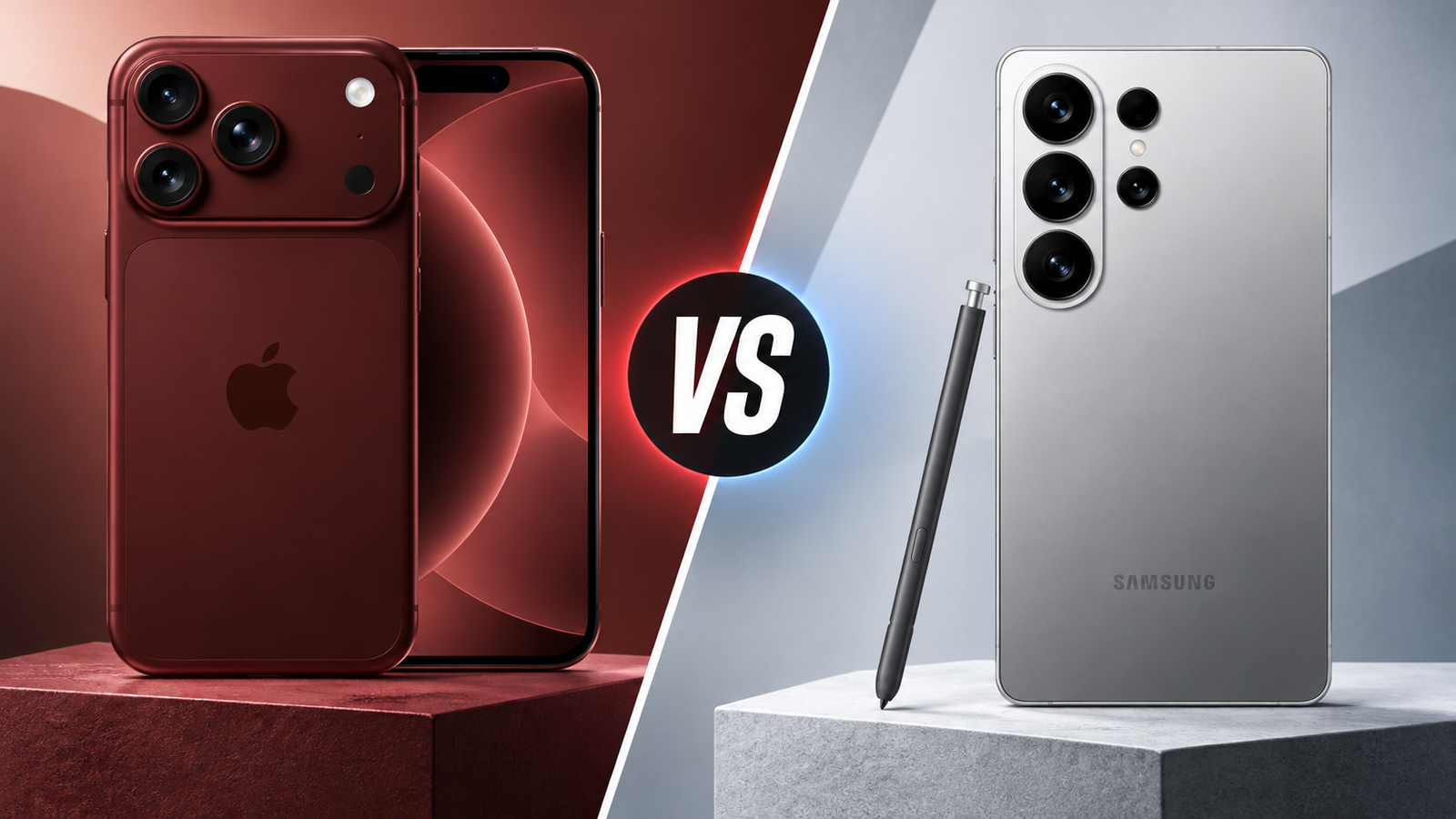
iPhone 18 Pro vs Galaxy S26 Ultra
4 views
Buying a $1,200-plus smartphone is easy.
Living with it is harder.
A spec sheet might tell you that the iPhone 18 Pro has a 2nm A20 Pro chip, while the Galaxy S26 Ultra carries Qualcomm's Snapdragon 8 Elite Gen 5 for Galaxy. It won't tell you which phone is less irritating when you're moving files, shooting video, working from a café, travelling, or trying to read a message on a crowded bus.
That is where this comparison gets interesting.
The iPhone 18 Pro vs Galaxy S26 Ultra matchup isn't simply Apple against Samsung. These phones take noticeably different approaches to cameras, displays, AI, battery management, connectivity, and everyday control.
Apple's iPhone 18 Pro starts at $1,199 with 256GB, while Samsung launched the Galaxy S26 Ultra at $1,299.99 for 256GB in the US.
And there are some surprisingly practical differences hiding underneath those prices.
iPhone 18 Pro vs Galaxy S26 Ultra: The key specifications
Feature | iPhone 18 Pro | Galaxy S26 Ultra |
|---|---|---|
Starting price | $1,199 | $1,299.99 |
Base storage | 256GB | 256GB |
Storage options | 256GB, 512GB, 1TB, 2TB | 256GB, 512GB, 1TB |
Display | 6.3-inch | 6.9-inch |
Processor | Apple A20 Pro | Snapdragon 8 Elite Gen 5 for Galaxy |
Operating system | iOS 27 | Android 16 |
Main camera | 48MP Fusion, variable aperture | 200MP, f/1.4 |
Ultra-wide | 48MP | 50MP, f/1.9 |
Telephoto | Pro camera system | 50MP 5x + 50MP 10x optical-quality |
Battery | Apple rates up to 36 hours video playback | 5,000mAh, up to 31 hours video playback |
Stylus | No | Integrated S Pen |
Cellular modem | Apple C2 | Qualcomm modem platform |
Wi-Fi | Wi-Fi 7 | Wi-Fi 7 |
Water resistance | IP68 | IP68 |
Samsung's Ultra is physically larger at 163.6 × 78.1 × 7.9mm and 214g, while the iPhone 18 Pro is a much smaller 6.3-inch device.
That size difference isn't cosmetic.
You feel it every time you use the phone one-handed.
Design and display: compact Pro versus giant Ultra
The iPhone 18 Pro keeps a 6.3-inch display, whereas the Galaxy S26 Ultra stretches to 6.9 inches. Samsung also builds its new Privacy Display directly into the screen, allowing the user to reduce side-angle visibility for the entire display, selected apps, notifications, or sensitive fields such as passwords.
That's a genuinely practical Samsung feature.
Picture yourself entering a banking password on a train. A conventional privacy protector can make the screen look worse from every angle. Samsung's implementation can instead be activated from the Quick Panel or assigned to a Side-button shortcut.
There is a trade-off, though. Samsung acknowledges that Privacy Display can alter image quality and doesn't make the screen completely invisible from every possible viewing position.
Apple's smaller chassis goes in another direction. The iPhone 18 Pro gets a redesigned Dynamic Island capable of showing up to three Live Activities simultaneously, while Face ID remains integrated into the system.
For someone who spends hours reading, editing spreadsheets, watching video, or using split-screen-style multitasking, the Galaxy's 6.9-inch canvas is simply more spacious.
For pockets, one-handed typing, and less hand gymnastics, the iPhone makes more sense.
The display decision is really a size decision.
Camera comparison: Samsung brings more hardware, Apple adds control
This is one of the most interesting parts of the iPhone 18 Pro.
Apple has added a variable-aperture 48MP Fusion Main camera with four selectable aperture positions: f/1.48, f/1.8, f/2.8, and f/4.0. The native Camera app also gains manual controls for shutter speed, white balance, and focus.
That's a meaningful change for people who actually want to control the camera rather than simply point and shoot.
Shooting indoors? Aperture becomes another creative variable.
Want more depth of field? Stop it down.
Trying to make a portrait look less computational? Manual control gives you more room to experiment.
Samsung attacks the problem differently. The Galaxy S26 Ultra uses a 200MP f/1.4 main camera, a 50MP f/1.9 ultra-wide, and 50MP telephoto hardware, including a 5x telephoto and a 10x optical-quality zoom mode.
That makes the S26 Ultra particularly interesting for travel photography.
A distant building. A performer on stage. Wildlife across a lagoon.
You don't have to crop everything afterward.
Samsung also highlights improved low-light video through wider apertures and noise reduction, while its ProVisual Engine handles computational image processing.
The distinction is subtle but important: Samsung gives you an unusually broad camera toolkit; Apple is pushing deeper manual control into its own camera workflow.
Performance: A20 Pro versus Snapdragon 8 Elite Gen 5
Apple's A20 Pro is built on a 2nm process and uses a 6-core CPU, 7-core GPU, and dual 16-core Neural Engine configuration. Apple says the chip offers up to 40% higher sustained performance than the previous generation, helped by a new vapor-chamber cooling system.
The thermal change matters more than benchmark bragging.
Phones often feel fast for ten minutes.
The annoying part comes later.
Samsung uses the Snapdragon 8 Elite Gen 5 for Galaxy and pairs it with a redesigned vapor chamber. Samsung says the new cooling system provides 21% greater thermal performance compared with the previous generation.
That should matter during long gaming sessions, 4K video editing, navigation with mobile data active, or repeated AI processing.
Neither phone is remotely slow.
The more useful question is sustained performance. If you regularly push a phone for 30–60 minutes at a time, thermal management becomes much more relevant than a single benchmark number.
Battery life: capacity isn't the whole story
Samsung gives the Galaxy S26 Ultra a 5,000mAh battery and rates it for up to 31 hours of video playback. Samsung also says the device can reach 75% charge in roughly 30 minutes under supported charging conditions.
Apple doesn't publish battery capacity in the same way, but its official figures put the iPhone 18 Pro at up to 36 hours of video playback. Apple also says the phone can reach 50% charge in around 15 minutes, with compatible charging equipment.
Don't compare those numbers as if they were laboratory equivalents.
Apple and Samsung use different testing methodologies, software stacks, displays, and power-management strategies.
What matters in real use is the pattern.
If your day involves Google Maps, 5G, Bluetooth earbuds, camera use, social apps, and video uploads, standby efficiency can matter as much as battery capacity. The iPhone 18 Pro's efficiency-focused A20 Pro platform is particularly interesting here, while the Galaxy counters with a larger physical battery.
Software: iOS 27 versus Android 16
This is where switching platforms gets expensive.
Not financially. Habitually.
The iPhone 18 Pro runs iOS 27 and adds Apple's latest Apple Intelligence features, including the company's next-generation Siri capabilities. Apple also integrates its AI features deeply into system apps and personal-context workflows.
Samsung's Galaxy S26 Ultra runs Android 16 with Galaxy AI features such as Photo Assist. Samsung's implementation lets users describe edits in natural language rather than manually performing every operation.
There are smaller workflow differences, too.
On iPhone, AirDrop remains extremely convenient if your household already uses Macs and iPads. iCloud keeps photos, files, and backups closely tied to the Apple ecosystem.
Samsung gives you considerably more freedom around launchers, file handling, multitasking, USB workflows, default applications, and the broader Android ecosystem.
And then there's the S Pen.
The S Pen changes the Galaxy equation
The Galaxy S26 Ultra has something the iPhone 18 Pro simply doesn't: an integrated S Pen.
It isn't just a party trick.
You can pull the stylus from the phone and immediately annotate documents, sketch ideas, select text, or write notes without carrying another accessory.
For students, designers, field workers, salespeople, and anyone who signs or marks up documents frequently, that can eliminate a surprisingly annoying part of daily phone use.
Apple's answer is different: a tighter ecosystem and increasingly capable camera and AI software.
Neither approach replaces the other.
Storage and price: look past the entry model
The iPhone 18 Pro starts at $1,199 for 256GB and goes through 512GB, 1TB, and a substantial 2TB configuration.
Samsung's S26 Ultra starts at $1,299.99 for 256GB, with 512GB and 1TB versions; the 1TB model includes 16GB RAM, while the smaller configurations use 12GB.
Samsung's US store has also been showing substantial discounts from launch pricing, with the 256GB model recently listed at $1,099.99 rather than its $1,299.99 original price.
That's worth remembering before declaring either phone "more expensive."
Retail pricing moves.
Trade-in values move.
Carrier promotions move even faster.
If you're comparing the two today, use the actual checkout price in your country rather than relying on launch MSRP.
Which phone fits which user?
If you care most about... | The relevant phone |
|---|---|
Smaller flagship body | iPhone 18 Pro |
Huge display | Galaxy S26 Ultra |
Integrated stylus | Galaxy S26 Ultra |
Long-range zoom flexibility | Galaxy S26 Ultra |
Variable-aperture photography | iPhone 18 Pro |
Manual camera controls | iPhone 18 Pro |
Android customization | Galaxy S26 Ultra |
Apple ecosystem integration | iPhone 18 Pro |
Built-in screen privacy | Galaxy S26 Ultra |
2TB internal storage option | iPhone 18 Pro |
There isn't a useful universal winner here.
The hardware priorities are too different.
A MacBook owner with AirPods, Apple Watch, and years of iCloud photos has a very different upgrade calculation from someone using a Windows laptop, Galaxy Buds, Google Photos, and an S Pen for work.
That context can outweigh a processor benchmark.
iPhone 18 Pro vs Galaxy S26 Ultra: 5 practical FAQs
Is the iPhone 18 Pro cheaper than the Galaxy S26 Ultra?
At launch, yes. The iPhone 18 Pro starts at $1,199 for 256GB, compared with $1,299.99 for the 256GB Galaxy S26 Ultra in the US. Actual street prices can differ because Samsung frequently runs promotions.
Does the Galaxy S26 Ultra have a better zoom camera?
Its camera hardware gives it a broader dedicated telephoto setup, including 5x and 10x optical-quality options. That makes the S26 Ultra particularly suited to distant subjects.
Is the iPhone 18 Pro better for photography?
It depends on what you shoot. Apple adds variable aperture and manual shutter, white-balance, and focus controls, while Samsung offers a higher-resolution main sensor and more extensive telephoto hardware.
Does the Galaxy S26 Ultra have a privacy screen?
Yes. Privacy Display is built into the S26 Ultra and can be configured for full-screen privacy, selected applications, notifications, PINs, passwords, and other sensitive content.
Which has better battery life?
The manufacturers quote different measurements, so direct comparisons need caution. Apple rates the iPhone 18 Pro for up to 36 hours of video playback, while Samsung rates the S26 Ultra for up to 31 hours.
The practical takeaway before you buy
The iPhone 18 Pro vs Galaxy S26 Ultra decision becomes much clearer if you ignore the marketing language for a moment.
If you want a comparatively compact flagship with Apple's A20 Pro platform, variable-aperture photography, manual camera controls, deep iOS integration, and up to 2TB storage, the iPhone 18 Pro is the more natural fit.
If you want a huge 6.9-inch display, integrated S Pen, extensive zoom hardware, Android flexibility, 5,000mAh battery capacity, and Samsung's built-in Privacy Display, the Galaxy S26 Ultra takes a very different—and very feature-dense—approach.
Before ordering, do one boring thing that saves a surprising number of regrets: check your existing devices first.
Look at your laptop. Your watch. Your earbuds. Your cloud storage. Your photo library. The apps you use for work.
Then check the exact storage tier and current local price.
That five-minute audit tells you far more about which flagship belongs in your pocket than another hundred benchmark charts.
iPhone 18 Pro vs Galaxy S26 Ultra
iPhone 18 Pro comparison
Galaxy S26 Ultra review
flagship phone comparison 2026
best premium smartphone 2026
Found this helpful? Share it!